
August 9, 2026
Metallic Epoxy in a Murphy, NC Warehouse: Why a Commercial Slab Doesn't Have to Look Like One
Most warehouse floors get one of two treatments. Either they get sealed and forgotten, or they get a flat gray coating that does its job and asks for nothing else.
This one went a different direction.
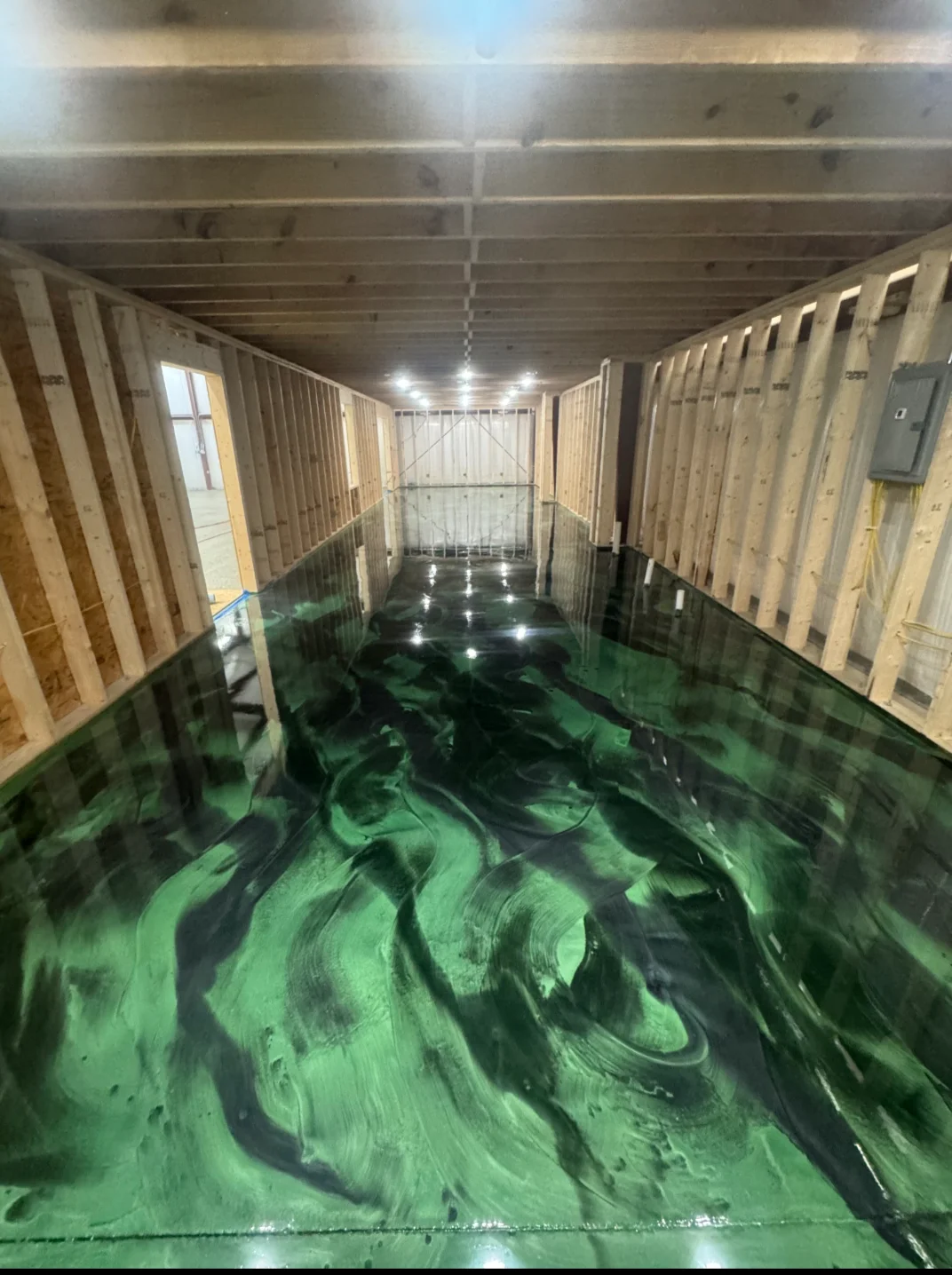
We recently finished a metallic epoxy installation in a warehouse in Murphy, North Carolina: deep emerald green with black marbling running through it, poured across the interior while the space was still being framed out. Bare studs, exposed wiring, plastic still on the walls. And a floor that already looked more finished than most retail spaces.
If you're putting office space, a showroom, a shop area, or any customer-facing square footage inside a metal building, this is what's possible on the slab you already have.
What Is Metallic Epoxy?
Metallic epoxy is a two-part resin system with reflective metallic pigment suspended in it. When it's poured and worked on the slab, that pigment separates, pools, and moves, and that movement is what creates the depth.
It isn't printed. It isn't stamped. It isn't a stencil. The pattern forms chemically and by hand while the material is still wet, which means no two metallic epoxy floors are the same. You can steer it. You can't duplicate it.
The result is a surface that's completely flat and seamless but reads like you're looking down into water. On this Murphy job, the green catches the overhead lighting and the black recedes behind it, so the floor shifts depending on where you're standing in the room.
Why This Works in a Commercial Building
A warehouse slab is usually the largest single surface in the building and the one nobody thinks about. That's a missed opportunity if any part of that building is going to have customers, clients, or employees in it every day.
A few reasons metallic epoxy earns its keep in a commercial space:
- It's seamless. No grout lines, no seams, no planks. Nothing for dirt, water, or bacteria to get into.
- It's chemical resistant. Oil, grease, solvents, cleaners, and salt don't stain it.
- It cleans with a dust mop. No stripping, no waxing, no buffing schedule.
- It uses the slab you already have. No demo, no subfloor, no waiting on material.
- It does marketing work. People take pictures of these floors. That's not nothing.
The color choice mattered here too. Green is bolder than the charcoal or gray most people default to, but metallic epoxy rewards commitment: the reflective pigment needs contrast to do anything interesting. A saturated green against black gives the pour something to work with. And in a bright interior with light framing and a lot of overhead lighting, a dark floor anchors the space instead of washing out with it.
How We Install a Metallic Epoxy Floor
The finish gets the attention. The prep decides whether it lasts.
- Diamond grinding the slab. Concrete has to be mechanically profiled, ground with diamond tooling, to open the pores and strip any curing compound, sealer, glue, or contamination. Epoxy bonds to a profile, not to a smooth surface. Acid etching is not a substitute, and this step is where most failed epoxy floors were actually lost.
- Slab repair. Cracks, spalls, pop-outs, and control joints get addressed first. Metallic epoxy is a thin-film system. It telegraphs whatever is underneath it, and it will not bridge a moving crack.
- Moisture testing. Concrete drives vapor upward, and warehouse slabs are frequently poured without a proper vapor barrier underneath. Too much vapor drive and the coating delaminates six months later. If the numbers come back high, a moisture-mitigating primer goes down before anything else.
- Base coat. A pigmented base coat is rolled to full coverage. On this floor, that's the black, the color the metallic gets to play against.
- The metallic pour. The metallic layer goes down and gets worked while the resin is still wet. This is the artistic part, and it's the part with a clock running on it. Once the material starts to set, the design is locked in.
- Clear topcoat. A high-build clear coat seals the system, provides the gloss, and takes the actual wear. Depending on how the space gets used, that's a polyaspartic or urethane topcoat, and slip resistance can be built into it where it's needed.
One Honest Note About Warehouses
Metallic epoxy is a decorative system. It performs well under foot traffic, carts, rolling loads, and normal commercial use. But if you've got forklift lanes, dock plates, steel wheels, or dropped-tool abuse in a specific area, that zone is usually better served by a heavier-build industrial system.
Plenty of buildings run both: metallic in the office, showroom, retail floor, and corridors, and a high-build industrial coating in the working bays. We'll tell you which parts of your building want which. We'd rather scope it right than sell you the prettier product for the wrong room.
Where Else We Install Metallic Epoxy
- Garages and shops: resistant to oil, brake fluid, road salt, and hot tire pickup
- Retail floors, restaurants, and breweries: seamless and easy to sanitize
- Salons, gyms, and showrooms: hard to scuff, easy to clean
- Basements: nowhere for moisture to hide
- Barndominiums and open-concept residential: kitchens, living areas, hallways
- Offices, lobbies, and clinics: a finish that doesn't need replacing every few years
How Long Does It Last?
A properly prepped and topcoated metallic epoxy floor should give you 10 to 20 years, and often longer with a periodic recoat of the clear. Because the system is seamless, maintenance is a dust mop and the occasional damp mop with a pH-neutral cleaner. No wax, no strip, no buffing crew.
The failure mode is almost never the epoxy. It's prep that got skipped.
What Does It Cost?
Metallic epoxy runs more per square foot than a solid-color epoxy or a standard flake system, because of the extra pigment layers and the hands-on labor during the pour. Final pricing comes down to:
- Total square footage
- Slab condition: grinding, patching, joint and crack repair
- Whether moisture mitigation is required
- Color complexity and topcoat selection
We quote after seeing the slab. Not over the phone off a square footage number. The slab tells us what the job actually costs, and we'd rather give you a real number than a low one we have to walk back.
Serving Murphy, NC and the Surrounding Region
Miller's Wholesale Flooring installs metallic epoxy, industrial coatings, and polished concrete throughout western North Carolina and East Tennessee, including Murphy, Andrews, Hayesville, Robbinsville, Marble, and Brasstown across Cherokee and Clay counties, plus our home area around Madisonville, Sweetwater, Athens, Vonore, Tellico Plains, and Maryville, Tennessee.
We sell retail, we sell wholesale, and we install everything we sell. The crew standing on your slab works for the same company that sourced the material.
Frequently Asked Questions
Can metallic epoxy handle warehouse traffic?
It handles foot traffic, carts, and rolling loads well. For forklift lanes, dock areas, or heavy point loads, we typically recommend a higher-build industrial system in those specific zones and metallic in the finished areas.
Can you coat an existing warehouse slab?
Usually yes. The slab has to be structurally sound, and any existing coating, sealer, or adhesive has to be ground off first. We evaluate the slab before committing to it.
How long before we can use the space?
Typically light foot traffic within 24 hours and full cure in roughly 5 to 7 days, depending on product and temperature. Equipment, racking, and heavy loads wait for full cure.
Is it slippery?
Gloss epoxy is slick when wet, the same as polished tile. We can build a slip-resistant additive into the topcoat for entries, wash areas, or anywhere OSHA-conscious.
Can you match a specific color?
We can work toward a color. We can't reproduce an exact pattern. The marbling is created by the material as it cures, which is the whole point of the finish.
Does it work outdoors?
Standard epoxy ambers in UV light. For loading docks, patios, and exterior slabs we use a UV-stable system instead.
Got a Slab That Deserves Better?
Whether it's a warehouse in Murphy, a shop in Andrews, or a showroom back across the line in Tennessee, we'll come look at it and tell you honestly what it needs.
Call Miller's Wholesale Flooring at (423) 442-1697
433 Isbill Rd, Madisonville, TN 37354
MillersWholesaleFlooring.com
Planning a flooring project?
We supply and install across East Tennessee. Most estimates are scheduled within 1–2 business days.