
August 12, 2026
WPC vs SPC Flooring: Which One Should You Buy?
For the home you live in, buy WPC. For a commercial space, a rental, or a flip, SPC is often the smarter check to write. That's the short answer, and it's the same one we give across the counter in Madisonville every week.
But this matchup comes up so often at the shop that we've started calling it what it is: a title fight. So before we break down the film, the introductions.
Flooring out of the left corner! Coming in from Madisonville, Tennessee by way of box truck. The undisputed LVP champion of the world: WPC!
And flooring out of the right corner! Coming in once again from Madisonville, by way of the very same box truck, the challenger: SPC!
Both fighters are luxury vinyl plank. Both are waterproof straight through. They train in the same warehouse and they ride to your house on the same truck. The only real difference between them is the core in the middle of the plank, and that one difference decides which floor belongs in which building. Here's the tale of the tape.
What's the difference between WPC and SPC?
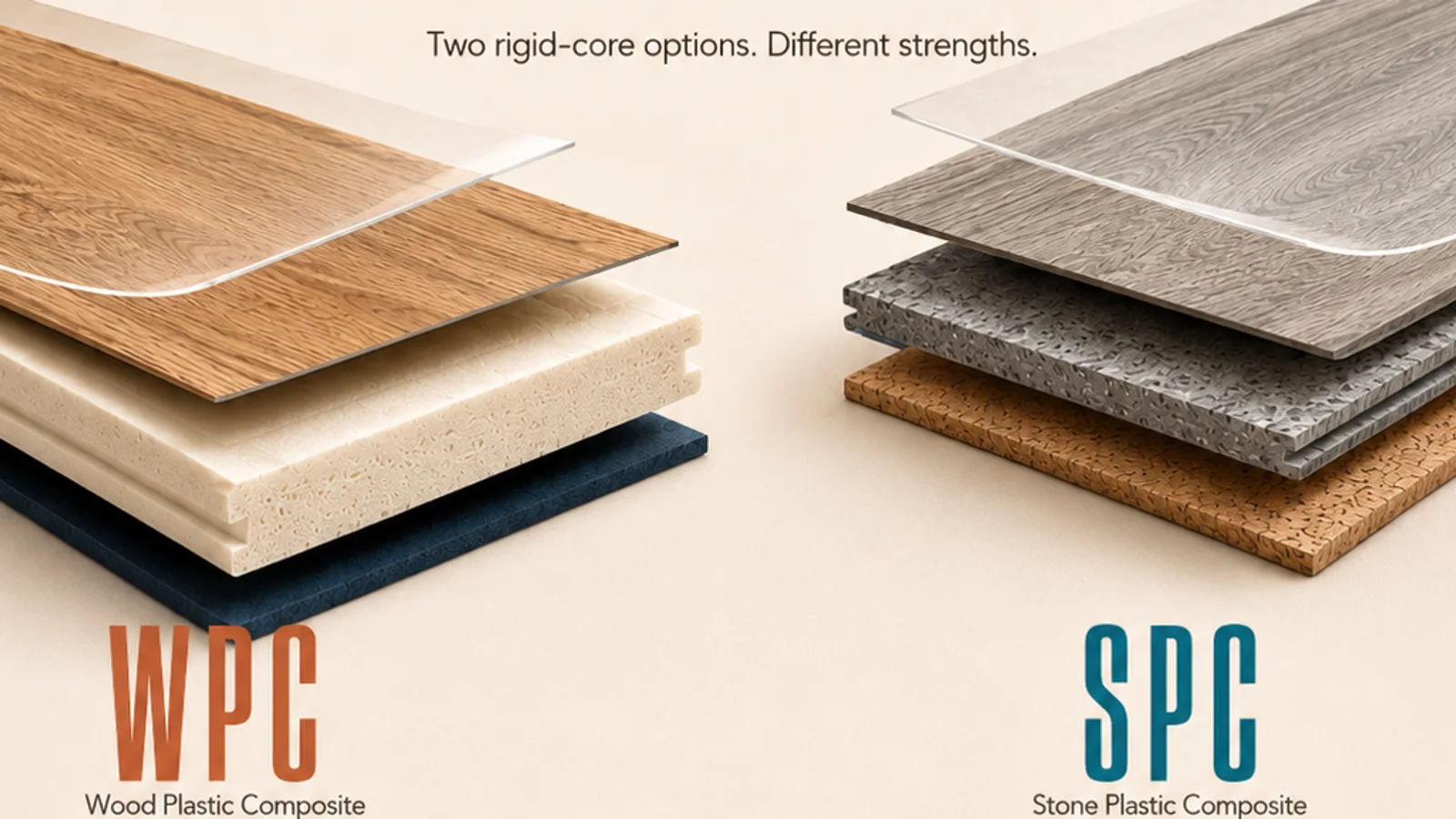
Every luxury vinyl plank is a stack: a clear wear layer you walk on, a printed woodgrain under it, a core in the middle, and usually a pad on the bottom. WPC and SPC are identical everywhere except that core, which is why the tape reads so differently on the two of them.
- WPC, the champ, stands for wood-plastic composite. The vinyl core is foamed with a wood-flour agent, so the plank fights at a heavier weight: thicker, warmer, quieter, and a little forgiving underfoot.
- SPC, the challenger, stands for stone-plastic composite. The vinyl core is loaded with powdered limestone, so the plank is lean and hard: dense, thin, and rigid.
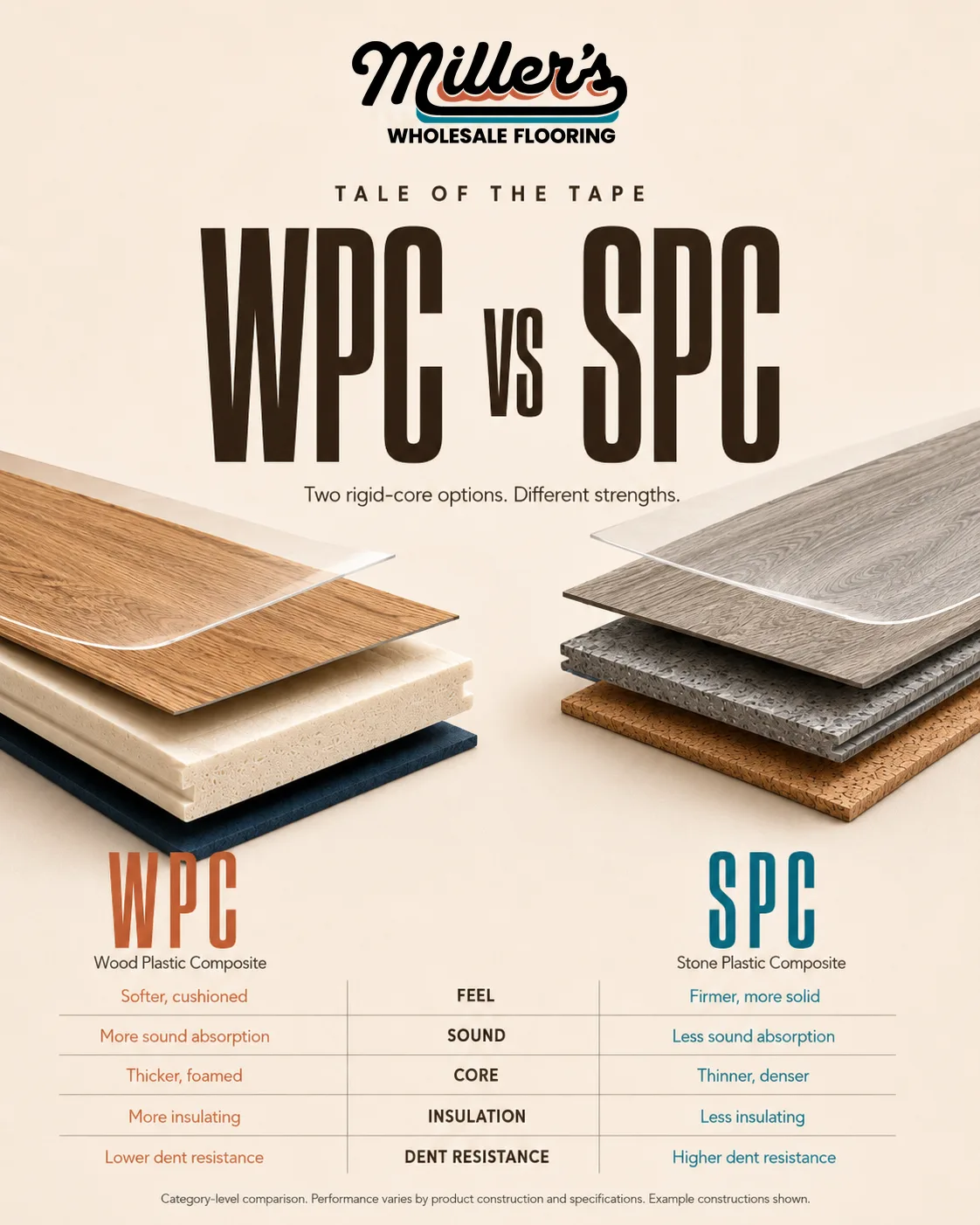
Neither one contains boards of wood or slabs of stone. Both are engineered vinyl, and both stand up to real household traffic. If you want the full stack explained layer by layer, we took a plank apart in What Is LVP Made Of?
Which is better for a home, WPC or SPC?
WPC, and for us this isn't a split decision. A house is a long fight, and the championship rounds here are East Tennessee's seasons: thick summer humidity into dry winter heat, year after year. Every floor in the region expands and contracts with those swings, and this is where the champ's conditioning shows. A WPC core rides that movement out and stays flat, tight, and quiet into the late rounds. We've watched WPC floors go the distance through Tennessee seasons where SPC struggles, and on a wood subfloor the gap gets wider: WPC will outlast SPC there by a good margin.
WPC also wins the rounds you actually live in. It's warmer to bare feet, softer when you're standing at the sink, and quieter when a kid drops something. Those are small points on day one and a wide scorecard in year six.
For the home you live in, the champ keeps the belt: WPC, by unanimous decision.
Is SPC more durable than WPC?
This is the challenger's best punch, and it deserves a straight answer. SPC's limestone core is harder, so it resists dents from a dropped pan or a chair leg a little better. SPC is very hard to dent. So is a sidewalk. Whether you want to live on one is a different question.
Here's what the punch stats don't show: dents aren't what wears a floor out. Floors lose the fight from the top down, and the number that decides how long the finish survives kids, dogs, and grit is the wear layer, the clear coating on top, measured in mils (thousandths of an inch). A 20 mil wear layer on a WPC plank will outlast a thin wear layer on the hardest SPC ever made. One big punch doesn't win a twelve-round fight. For the home you live in, get at least a 20 mil wear layer and put your attention there.
When is SPC the right buy?
Every good fighter has a weight class where they're dangerous, and we'll be the first to say there are fights the challenger wins clean.
- Commercial spaces. This is SPC's home arena. For storefronts and offices we spec SPC installed glue-down, not floating, so rolling loads and all-day traffic land on a floor that's anchored to the slab. In a commercial building, SPC takes the belt.
- Rentals and flips. A floating SPC goes down fast, performs well over a flat, level slab, and costs less. We keep 12 mil SPCs in stock for exactly this buyer, because a rental floor needs to be presentable and replaceable, not permanent.
- Tight budgets. If the numbers only work with SPC, a floating SPC is an honest floor we'll happily sell you. It beats stretching for a floor that strains the rest of the project.
Which costs more, WPC or SPC?
WPC generally runs more per square foot than SPC, and whether that purse is worth paying depends entirely on whose feet will be on the floor. Flipping a property or outfitting a rental? The math favors SPC, buy the SPC. Flooring the house you'll live in for the next twenty years? The difference disappears into the years you don't spend replacing it, and with our wholesale pricing a 20 mil WPC from us often lands near what a thinner plank costs at a big box store.
One more venue where this fight gets decided around here: lake houses. A home sitting on Tellico Lake lives at the humid end of an already humid region, which is exactly the condition the champ trains for. We wrote up the whole reasoning in What's the Best Flooring for a Lake House?
The easiest way to score this fight yourself is to stand on both. We keep both fighters on the floor of our LVP lineup at the showroom in Madisonville, and you'll feel the difference in about ten seconds. Bring your room measurements, or request a free estimate and we'll bring the samples to you. Ringside seats are free.
Planning a flooring project?
We supply and install across East Tennessee. Most estimates are scheduled within 1–2 business days.