
October 28, 2025
Engineered Hardwood vs Solid Hardwood: What's the Difference?
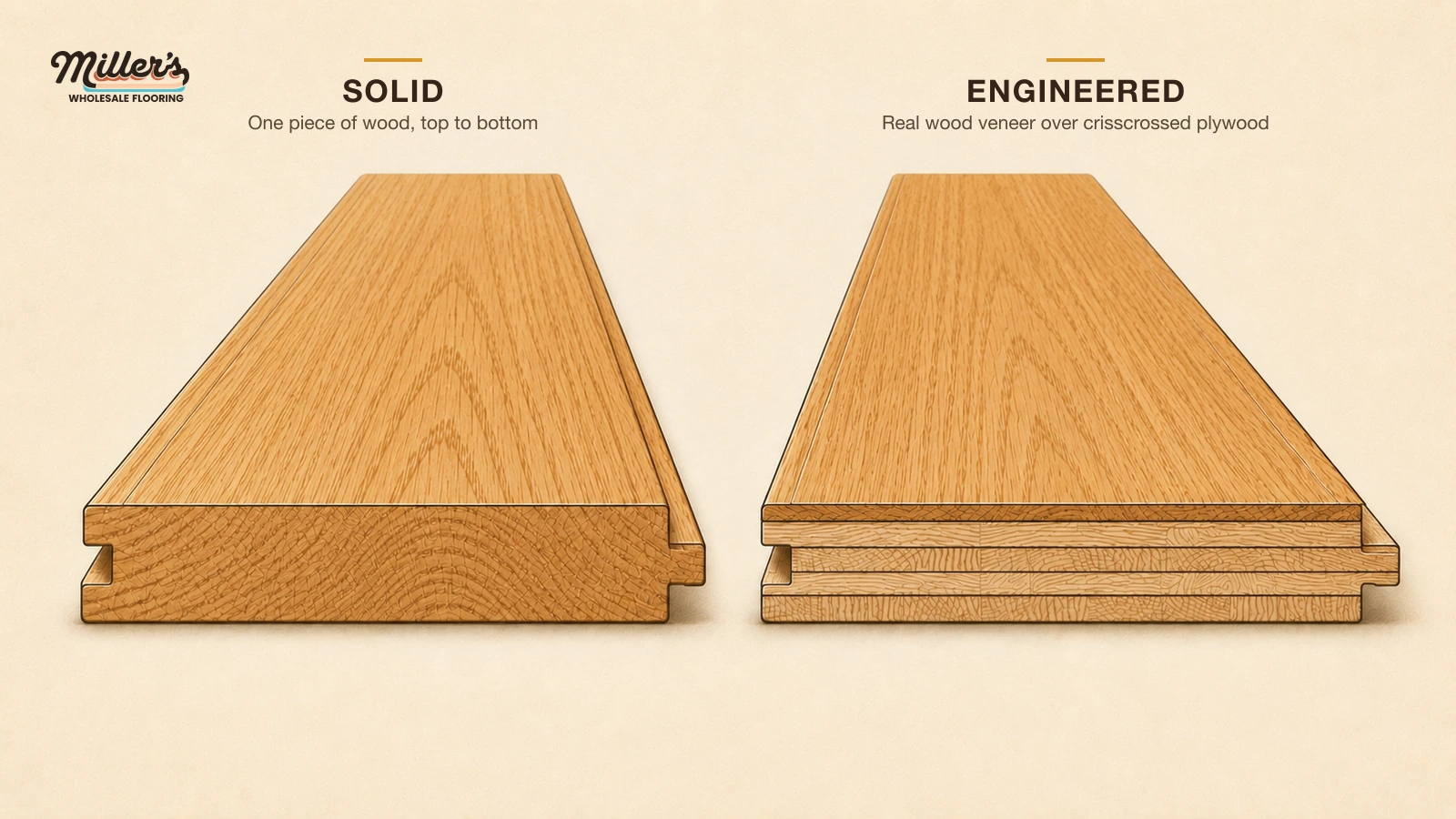
Solid hardwood is one piece of real wood, milled from top to bottom out of the same board. Engineered hardwood is a thin layer of that same real wood, called the veneer, bonded over a stack of plywood. Both are wood floors. Both are real. The difference is what sits underneath the part you see, and that difference decides which rooms each one can live in.
We've been selling and installing hardwood in Madisonville since 1970, and this is still the question we answer most at the counter. Here's how each one is built, where each one belongs, and which one we hand most customers today.
What is solid hardwood?
Solid hardwood is exactly what it sounds like: 100% real wood, milled into planks with a tongue and groove edge, meaning one side has a ridge and the other has a matching slot so the boards lock together as they go down. There is no core, no backing, and no veneer. It's wood all the way through.
That construction is why solid can be sanded and refinished several times over its life. It's also why it moves. Wood takes on moisture from the air and gives it back, so a solid floor grows a little in a humid East Tennessee August and shrinks a little in dry winter heat. That's normal, and it's why solid hardwood has to acclimate, which just means sitting in your house for a few days before install so it settles at your home's humidity instead of the warehouse's.
Solid hardwood shows up at your house with opinions about the weather.
Because it moves that much, solid belongs in above-grade living spaces, meaning any floor at or above ground level. Not basements. Not bathrooms. It gets nailed or stapled down to a wood subfloor, the structural deck under your finished floor, and it wants an installer who has done it before.
What is engineered hardwood?
Engineered hardwood is usually five or more layers of plywood, each one turned crossways to the layer under it, pressed together, with a layer of real hardwood bonded on top. That top layer is the veneer, and it's the floor you actually see and walk on. Sand an engineered oak floor and you're sanding oak, because it is oak.
The crisscrossed plywood underneath is the whole point. Wood moves most across the grain, so by turning each layer against the one below it, the layers fight each other's movement instead of adding it up. The result is a plank that stays much flatter through humidity swings than a solid board of the same width.
That stability buys engineered two things solid doesn't get: it can be glued down to concrete, and it can go in rooms where solid would cup or gap.
The veneer: the part you can refinish
Everything about an engineered floor's long-term life comes down to how thick that top layer of real wood is. A thin veneer can usually be sanded once. A thick one can take a few passes. It varies by product, and it's the number worth asking about before you buy, because it's the difference between a floor you can bring back and a floor you replace.
Solid still wins this category outright. There's so much wood in a solid plank that our sand and finish crews can typically take one back to bare wood three to five times. Bringing an old oak floor back is still one of the most satisfying jobs we do, and it's only possible because there's that much wood to work with.
With engineered, you're buying the veneer. Everything under it is there to keep the veneer flat.
Can you put hardwood in a basement?
Engineered, yes. Solid, no.
Basements sit below grade, against ground that holds moisture, and concrete slabs give off water vapor for years. A solid plank in that environment will cup, gap, or pull loose from its fasteners. Engineered handles it, and over a concrete slab it gets glued down rather than nailed, since there's nothing to nail into.
One condition on that: the slab has to be flat. Glue only does its job when the plank and the slab are actually touching across the whole board, so any hump or dip gets ground down or filled before a single plank goes in. We wrote up what that prep actually involves in Floor Preparation and Installation.
Can you put hardwood in a bathroom?
We don't recommend it, and that goes for engineered too.
People do it. Engineered's reputation for handling moisture leads folks to think it's waterproof, and it isn't. It's real wood on top of plywood, and both of those swell when water sits on them. A bathroom floor takes standing water off a shower door, out of a tub, and around a toilet base, year after year. That's a different job than seasonal humidity, and wood loses it.
If you want the wood look in a bathroom, a laundry room, or anywhere else water lands, that's what luxury vinyl plank is for. It's waterproof through the plank itself, and the LVP we carry has come far enough that guests kneel down and touch it before they believe it isn't wood. Same reasoning we use on the lake, where hardwood belongs upstairs and away from the water door: What's the Best Flooring for a Lake House?
Which one do we sell more of?
Engineered, and it isn't close anymore. We glue down far more engineered than we nail these days, and most of what goes out our door is wide plank.
That's mostly what customers want. Wide boards read as calm and modern in a room, and a 3 1/4 inch strip floor reads as traditional. But it's also physics. The wider a solid board gets, the more it moves across its width, and the bigger the gaps get when winter dries it out. Manufacturers went to engineered construction on the wide sizes for exactly that reason, and it's why the wide plank floor you liked in somebody's kitchen was almost certainly engineered.
Why wide plank has to be glued
Here's the rule we install by: at 4 inches and wider, engineered gets a full spread glue down, with total coverage. No stapling.
The reason is air. A staple holds the plank at the staple, and between staples on a wide board there's open space under the wood. Step on it and the plank flexes into that space, and that movement is what you hear as popping, squeaking, and cracking underfoot. Full coverage adhesive removes the space entirely. The plank is bonded to the subfloor across its whole back, so there's nothing to flex into. A wide plank floor we glued down that way is going to hold, and it isn't going to squeak.
Under 4 inches, the subfloor decides: wood gets nailed, concrete gets glued. Width only forces the issue once the boards get wide.
Two things worth knowing before you price a wide plank floor. The adhesive and the labor to spread it cost more than stapling, so the install method belongs in your budget alongside the box. And if you want the full breakdown of staple versus glue versus float, including the glue we stock and why, it's all in Gluing VS Stapling Hardwood.
When we'd tell you to buy solid instead
We sell mostly engineered, so here's the honest boundary on our own usual answer.
If your floor is above grade over a wood subfloor, you like a narrower board, and you're flooring a house you intend to hand down, buy the solid. Nothing engineered matches a floor that can be sanded back to bare wood three to five times. A solid oak floor is a long decision, and across that life it can be made new again more than once. That's a real advantage and we're not going to talk you out of it to sell you a wider plank.
And if the room in question is a basement bath, a mudroom, or the main level of a house on the water, we'll tell you to skip wood altogether. Buying the right floor for the room beats buying the floor you liked in a photograph.
Come stand on both in our Madisonville showroom and the difference stops being theoretical. We'll show you veneer thicknesses side by side and tell you straight which one your rooms are asking for. If you'd rather start from your own floor plan, request a free estimate and we'll bring the samples to you. You can see the hardwood lines we carry and install any time.
Planning a flooring project?
We supply and install across East Tennessee. Most estimates are scheduled within 1–2 business days.